

Nghe An community tourism aims for sustainable development
- class2group6term225
- Mar 25, 2025
- 6 min read
Nghe An has issued a number of policies to help people in mountainous districts develop sustainable livelihoods and create a foundation for localities to better promote national cultural identity and regional characteristics.
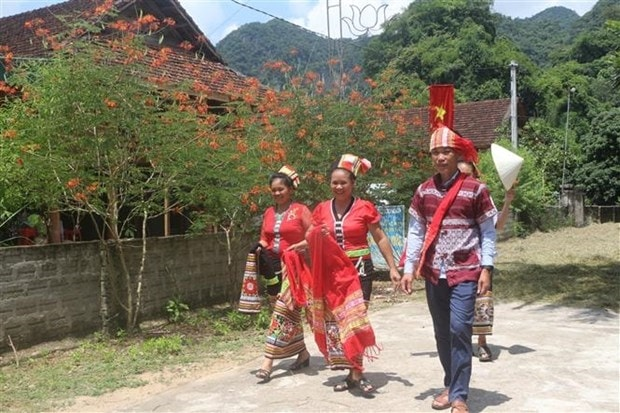
Community tourism is a form of green tourism, not only diversifying tourism products, helping tourists have more experiences but also aiming at the goal of sustainable development of local communities, preserving indigenous culture.
Nghe An is a locality with great potential to develop this type of tourism. However, to be successful, localities need to have policies to support and encourage the development of community tourism.
Preserving indigenous cultural identity
Phay Thai Minh village in Tien Ky commune is one of the destinations chosen by the district to build into a community tourism site. This is a village with 100% Thai ethnic people with many unique cultural identities preserved quite intact.
From the existing foundation of ancient stilt houses, Tien Ky commune has selected four households with sufficient conditions to serve as community tourism accommodation. Coming to Phay Thai Minh village, visitors can live according to the customs of Thai families such as: staying in stilt houses, eating traditional dishes of local people, experiencing brocade weaving, and watching the process of making Tien Dong wine.
More than three years ago, Mr. Vi Van Xao's family invested more than 100 million VND to repair and upgrade the stilt house, invest in 10 sets of blankets, sheets, pillows, mattresses and build new toilets. Mr. Vi Van Xao said that when it was chosen as a community tourism destination, his family was very excited and invested money to develop this type of tourism. He hopes that the locality will have a plan to cooperate with companies or travel tours to attract more tourists to experience.
Tien Ky commune has Pu Loi peak 1,100m above sea level with a system of limestone mountains and majestic, poetic caves. Especially located at the foot of Pu Loi mountain, Hang Mo still retains the ecosystem where traces of primitive people have been discovered.
In recent times, after the detailed planning of the Mo cave tourist site associated with the Phay Thai Minh brocade weaving village, Tan Ky district has made efforts in preserving and gradually promoting the cultural identity of the Thai people as well as the natural landscape in the area; at the same time, restoring the Buon Xao Festival, successfully building the harem house of Le Thai To temple and auxiliary works at the Le Loi citadel historical relic site to become a meaningful spiritual tourist destination.
Despite active participation, the development of Phay Thai Minh village and Tien Ky commune into a tourist destination still faces many difficulties. Mr. Nguyen Van Thach, Chairman of Tien Ky Commune People's Committee, said that the most difficult thing is that investment capital for the tourism sector is still limited.

Therefore, the budget to invite tourism experts to guide the implementation of related contents and develop tourism service points (such as Mo cave, Phay Thai Minh village, service areas according to the province's planning) has not been implemented.
Besides, the conditions for tourism development in the locality still face many difficulties and the essential elements of tourism are not synchronized, especially in terms of transport infrastructure to tourist destinations. Currently, tourism development in Tien Ky is just the beginning.
However, to become an attractive destination, the locality needs time. Because, essential services in the area are still too modest, there are no typical products, the tourism team at the locations still lack knowledge and expertise in community tourism.
Since 2016, the community tourism model has been developed in Na village, Yen Khe commune, Con Cuong district. This is considered one of the first community tourism models in Nghe An that has been maintained to this day.
Ms. Vi Thi Thanh, owner of Nhuong Thanh homestay, said that since being chosen to be a homestay, she has renovated the entire campus, accommodation for tourists and the landscape of the house. Over the years, she has welcomed thousands of visitors, most concentrated on peak occasions such as April 30, September 2...
Con Cuong district currently has four community tourism sites in operation: Khe Ran village (Bong Khe commune); Nua village, Pha village (Yen Khe commune) and Xieng village (Mon Son commune). Thanks to that, local people can promote their existing potential and strengths, boost economic development, and increase family income.
Previously, since 2016, experts from the JICA project (Japan) - a project to diversify livelihoods based on agricultural, forestry and fishery villages - have guided people to do community tourism and establish tourism service groups.
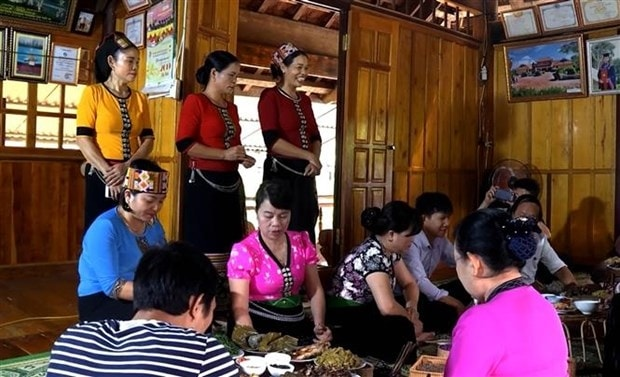
In addition, JICA project experts have researched, designed and helped people make orange baskets for tourists using locally available materials (rattan, bamboo, etc.), environmentally friendly and with the characteristics of the Thai people; supported the design of logos, labels, packaging, barcode registration, and food hygiene and safety inspection.
Of the four community tourism destinations in Con Cuong, two (Nua village, Yen Khe commune and Khe Ran village, Bong Khe commune) were evaluated and classified as 4-star OCOP products by the Council and Advisory Group. Since its establishment, community tourism has welcomed 49,178 visitors to visit and enjoy the cuisine of the Thai ethnic group. Total revenue from this type of tourism is more than 7 billion VND.
Need support policy
In reality, community tourism sites in Nghe An are still small-scale within family premises; there is no connection or association to form a tourism complex like in many other models. Tourists coming to this type of tourism mainly stop at eating, sleeping and do not have many attractive experiences to be able to stay long term.
Mr. Tran Cong Hien, Deputy Head of the Department of Culture of Con Cuong district, expressed his concern that from the available potential, the locality hopes that the province needs to issue policies, programs, projects and plans on tourism development investment, especially community tourism.
In addition, the province needs to support training and fostering people to work in tourism such as: opening specialized classes to learn and educate about the protection of natural resources and the environment; training classes to raise awareness about resources and tourism environment for the community at community tourism areas and spots; supporting propaganda, promoting and introducing products, paying attention to building tours and routes to bring visitors to explore Con Cuong tourism.

To develop community tourism, Nghe An has issued a number of development support policies to help people in mountainous districts develop sustainable livelihoods and create a basis for localities to better protect and promote national cultural identity and regional characteristics.
The support fund aims to help localities carry out propaganda, promotion, tourism promotion and professional training; at the same time, it partially supports families to build toilets, purchase initial equipment (blankets, sheets, pillows, mattresses, water filters, etc.); support the performing arts teams of villages and hamlets to purchase musical instruments and performance costumes to serve tourists.
Through the implementation process, the support for the development of community tourism has been effective. However, local people have not yet accessed this policy for many different reasons. This is also one of the reasons why community tourism in Nghe An, despite its potential, has not developed as expected.
According to tourism experts, to develop sustainable community tourism, tourism development policies need to be integrated into other policies on regional development, community development, new rural construction policies, policies to encourage agricultural and rural development, policies related to the preservation and promotion of national cultural heritage, training policies, human resource development, etc.
Along with that, the locality needs to invest in infrastructure and transportation; support training and service development; restore and develop traditional occupations, and support the construction of a chain of links for community tourism development.





Comments